Google’s Gemini 3.8 Flash Wants AI Agents to Stop Just Answering and Start Doing
Google’s latest Gemini 3.8 Flash is positioning itself as a high-performance, cost-efficient AI model, combining strong benchmark results with lower pricing than several competing frontier models. The new model targets everything from software engineering and finance to legal workflows, research, chart reasoning and long-form video understanding.
Google’s latest Gemini release takes aim at a bigger challenge for AI: making models capable of handling complex, multi-step tasks with less human intervention.
For the past few years, the AI industry has largely revolved around a simple question: how good is a model at answering questions? That is rapidly changing. As AI moves into coding, research, enterprise software and cybersecurity, the more important question is becoming whether a model can actually complete a task from beginning to end.
Google’s new Gemini 3.8 Flash is built around that idea. Announced on September 2, 2026, the model is positioned as Google’s latest “workhorse” for coding, agentic workflows and complex reasoning. Alongside it, Google has introduced Gemini 3.8 Flash Cyber, a specialised version designed to help trusted defenders discover and fix software vulnerabilities.
The two models point to a broader shift in Google’s AI strategy: intelligence is increasingly being designed not just for conversation, but for action.
Gemini 3.8 Flash is designed for longer, harder tasks
Google says Gemini 3.8 Flash delivers substantial improvements over Gemini 3.7 Flash across software engineering, agentic tasks and multi-step reasoning. The company says the model can often approach the performance of more expensive frontier models while retaining the speed and cost advantages of the Flash family.
The key design change is that Gemini 3.8 Flash is intended to “work harder” when a problem demands it. On complex tasks, the model can execute additional reasoning steps and make iterative tool calls rather than attempting to solve everything in one pass. Developers can also choose lower effort levels when compute efficiency is more important.
That distinction matters because an AI agent behaves very differently from a conventional chatbot. Instead of simply generating a response, an agent can plan a task, use external tools, examine what those tools return, adjust its approach and continue working.
The real test is whether AI can finish the job
Google is putting particular emphasis on long-horizon software engineering. On the DeepSWE v1.1 benchmark, which evaluates autonomous software engineering, Google says Gemini 3.8 Flash outperforms most larger frontier models on complex engineering problems while operating at a fraction of their cost.
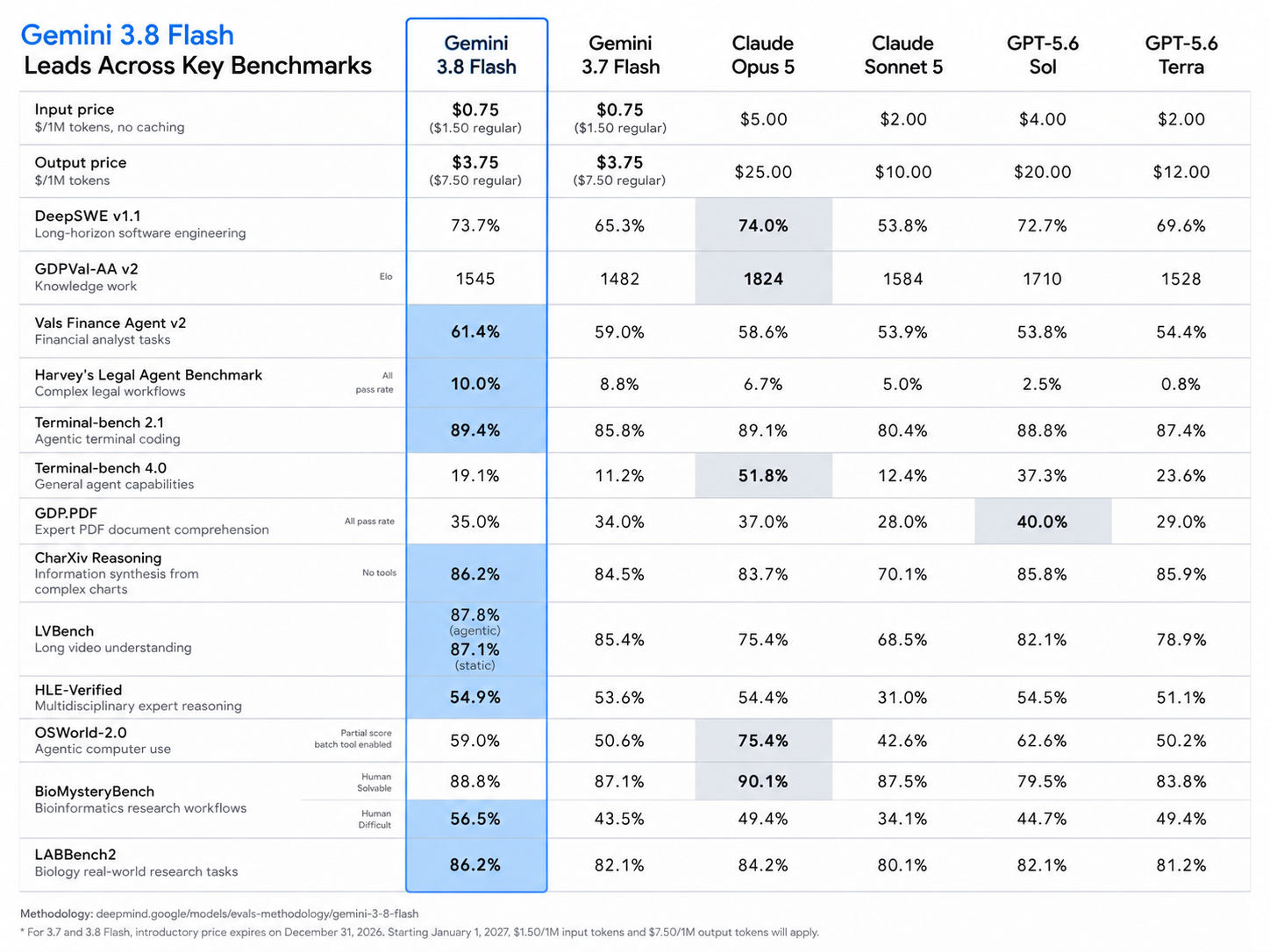
The company also reports a 54.9% score on HLE-Verified, a benchmark designed to test multi-step reasoning across STEM, humanities and professional fields. Gemini 3.8 Flash also improves on Gemini 3.7 Flash in benchmarks covering finance and legal-agent workflows.
For developers, the practical implication is that the model is being designed to handle more of the workflow itself. Rather than stopping after suggesting code, an agent can investigate an issue, modify a project, use available tools and assess the result before continuing.
Google is showing what that looks like in practice
Google’s demonstrations of Gemini 3.8 Flash are deliberately focused on what the model can build rather than simply what it can say.
Using Google Antigravity, Google says Gemini 3.8 Flash created a playable DOS version of Google Maps from a single prompt, complete with locations, directions and Street View. In another demonstration, it created a 3D wizard game featuring puzzles, environmental storytelling and textures generated using Nano Banana.
Google has also demonstrated the model creating interactive visualisations based on real US Geological Survey datasets and building “Hardware Anatomy”, a Three.js-based interactive visualiser that can represent physically proportioned hardware teardowns and allow users to inspect different layers of a device.
The significance of these demonstrations isn’t simply that an AI can generate a game or a web application. Models have been doing that for some time.
What is changing is the increasing distance between a user’s instruction and the finished result.
The traditional workflow involves a person describing what they want, receiving generated code or content, identifying problems, asking for corrections and repeating the process. Agentic systems are intended to handle more of that loop themselves.
Gemini 3.8 Flash Cyber takes the idea into cybersecurity
The second model Google announced may ultimately have an even more specialised impact.
Google has created Gemini 3.8 Flash Cyber specifically for cybersecurity, with a focus on autonomous vulnerability discovery and automated patching. Unlike a general-purpose model, its development is centred on giving defenders capabilities that can help them identify weaknesses and fix them.
On CyberGym, a benchmark for autonomous vulnerability discovery, Google says Gemini 3.8 Flash Cyber demonstrates frontier-level performance and surpasses Gemini 3.5 Flash Cyber as well as significantly larger frontier models.
Google also tested the model against an internal benchmark covering complex codebases across 20 programming languages. The company says Gemini 3.8 Flash Cyber achieved a success rate of more than 70% on this evaluation.
For patching vulnerabilities, Google cites the external CWE-Bench evaluation, where Gemini 3.8 Flash Cyber achieved a 47.2% pass@1 result, compared with 47.8% for a leading frontier model, while costing significantly less per rollout.
Google says the model is already finding real vulnerabilities
Google is not presenting Gemini 3.8 Flash Cyber as a purely experimental cybersecurity model.
The company says its own security teams are already using it to secure Google’s code. According to Google, the Chrome Security team found that Gemini 3.8 Flash Cyber produced 2.6 times more correct vulnerability patches than the best commercial models it tested, which were much larger.
Google’s Cloud Vulnerability Research team also used the model to discover a critical foundational vulnerability in less than two hours. Google says research and discovery of a vulnerability of this type would ordinarily take months.
If these results translate into broader real-world deployments, AI could help reduce the time security teams spend moving from identifying a software weakness to developing and testing a fix.
Google isn’t making the Cyber model openly available
There is an important caveat to Gemini 3.8 Flash Cyber.
Because cybersecurity AI has obvious dual-use implications, Google is limiting access to the model. It is being made available to a group of trusted defenders through Google’s Fairwind Program, which includes government authorities, critical infrastructure operators and software maintainers.
Google says Gemini 3.8 models include safeguards against misuse in areas including CBRN and cyber offense. The Cyber model has a more permissive cybersecurity mitigation approach because it is intended for trusted defenders, and access is consequently restricted.
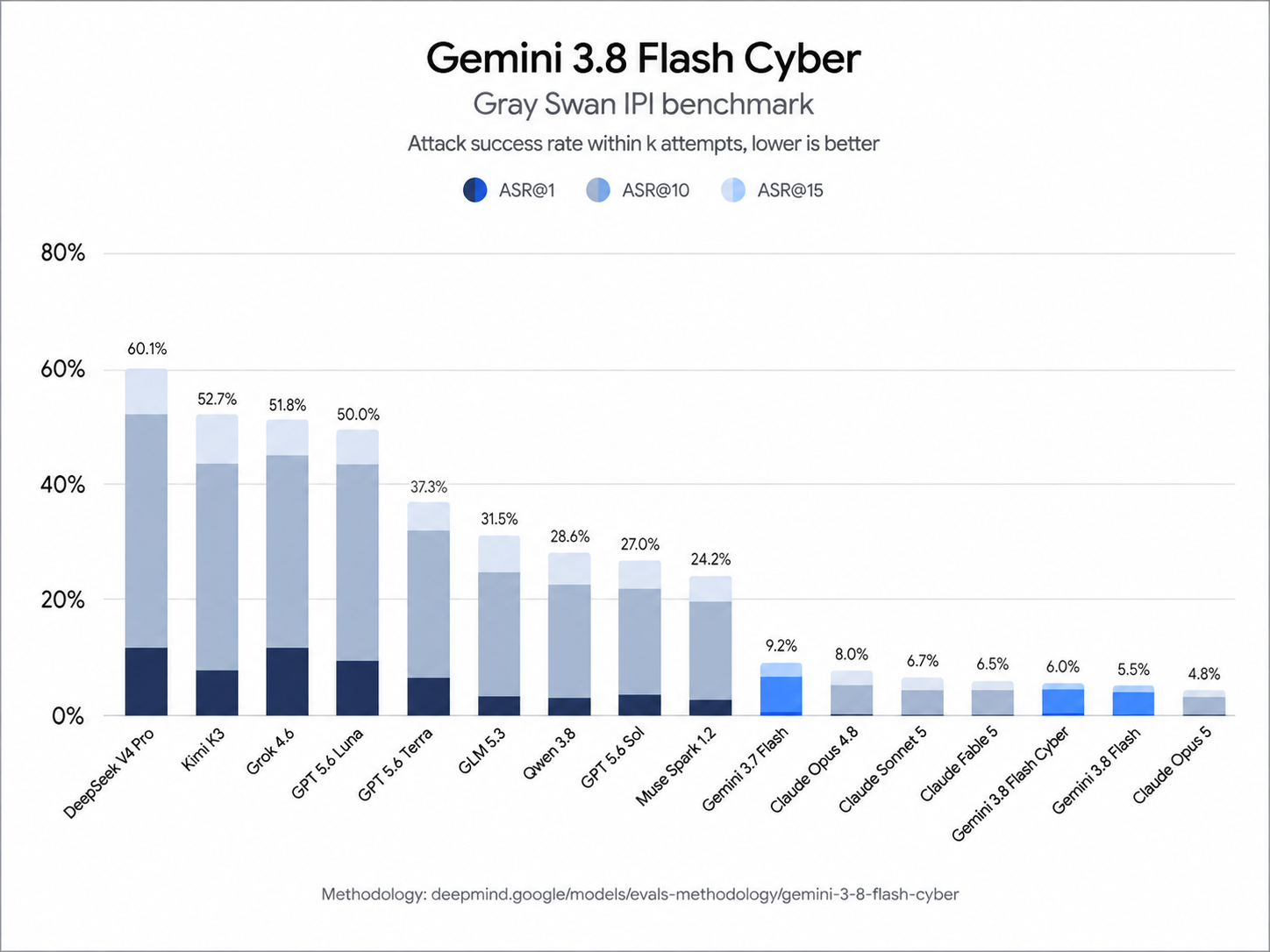
Google also says its Gemini 3.8 models have made a significant improvement in robustness against prompt injection attacks, based on measurements from Gray Swan.
That is particularly relevant for agentic systems. An AI that can use tools and take actions has a larger potential attack surface than a model that simply produces text. If an attacker can manipulate the information an agent sees and persuade it to take an unintended action, the consequences can extend beyond an incorrect answer.
The economics of agentic AI could matter just as much as intelligence
One of Gemini 3.8 Flash’s most interesting characteristics is its pricing.
Google says the model is available at an introductory price of $0.75 per million input tokens and $3.75 per million output tokens, the same introductory pricing used for Gemini 3.7 Flash. That pricing is particularly relevant for agentic applications, where completing a task can involve multiple rounds of reasoning and tool calls.
Google says this introductory pricing will remain in place until December 31, 2026. From January 1, 2027, the listed price will increase to $1.50 per million input tokens and $7.50 per million output tokens.
The argument is straightforward: when an AI agent needs to reason, call tools and iterate repeatedly, the cost of each interaction becomes important. A model that can reliably complete a complicated task at a lower operating cost could therefore be more attractive for developers than a larger model that performs better on individual prompts but costs considerably more to run.
Where developers can use Gemini 3.8 Flash
Gemini 3.8 Flash is available to developers through Google AI Studio and the Gemini API, as well as Android Studio and Google Antigravity. Google says enterprises can access it through Gemini Enterprise, while consumers can access Gemini 3.8 Flash through Google AI Pro and Ultra across the Gemini app, AI Mode in Google Search and Gemini in Google Sheets.
Gemini 3.8 Flash Cyber, meanwhile, is being offered through the Fairwind Program to selected trusted defenders.
This gives the two models distinct roles: one is intended as a broadly deployable model for developers and businesses, while the other is being kept within a more controlled environment because of its cybersecurity capabilities.
The next AI race may be about work, not answers
The significance of Gemini 3.8 Flash may ultimately have less to do with its position on any individual benchmark and more to do with what Google is choosing to optimise for.
The industry is moving beyond the era in which the primary objective was to build increasingly impressive chatbots. The emerging competition is about systems that can plan, reason, use tools, recover from mistakes and complete tasks over longer periods of time.
Gemini 3.8 Flash represents Google’s attempt to make that capability available in a faster, lower-cost model, while Gemini 3.8 Flash Cyber applies the same broader direction to cybersecurity.
If Google’s claims translate into reliable performance in the real world, the more important question about the latest Gemini model may not be whether it can answer a difficult question.
It may be whether, after receiving an instruction, it can actually finish the job.