
Haryana Police Creates AI Task Force: What Changes and What Other States Can Learn
Haryana Police has created a dedicated AI Task Force, appointing an IPS-rank officer as its AI Officer to drive the use of Artificial Intelligence in policing, particularly cybercrime investigations. The move signals a shift from isolated AI tools to a more structured, department-wide approach.
Artificial Intelligence is moving from the world of chatbots and generative tools into a very different arena: policing.
The Haryana Police has announced the creation of an AI Task Force, with an IPS-rank officer nominated as the AI Officer of Haryana Police to head the initiative. The announcement was made on August 31, 2026, and the police department says the move is aimed at increasing the use of AI in policing, particularly to make cybercrime investigations faster and more accurate.
But the significance of the announcement is not simply that Haryana Police is “using AI”. The bigger development is that AI is being given a dedicated organisational focus within the police force.
Why is Haryana Police creating an AI Task Force?
The immediate reason is the growing importance of Artificial Intelligence in policing.
Haryana Police’s own announcement describes AI as becoming increasingly important to the department and identifies cybercrime investigations as an area where AI can help make investigations faster and more accurate.

That matters because policing increasingly involves dealing with large volumes of digital information. Cybercrime investigations can involve digital records, communications, financial information and other forms of data that can be difficult to examine manually at scale.
The AI Task Force is therefore intended to give Haryana Police a dedicated mechanism for exploring and applying AI, rather than treating it simply as another IT tool.
There is also evidence that Haryana Police has already been experimenting with AI-enabled policing systems.
For example, the department’s Special Task Force operates EAGLE — Electronic & Analytic Gateway for Law Enforcement. Haryana Police describes EAGLE as a software application that digitises and centralises criminal records and can automatically generate digital dossiers. It uses AI-driven capabilities including facial recognition, advanced text search and phonetic search, while also conducting gang and criminal-link analysis to identify relationships between individuals.
The new task force can be seen in that broader context: building a more structured approach around technologies that can help police analyse information and investigate crime.
What will actually be different?
The most important change is institutionalisation.
Instead of AI being limited to individual projects or technology deployments, Haryana Police is creating a dedicated task force around the technology, headed by an IPS-rank officer designated as the department’s AI Officer.
That creates a central point of responsibility for AI within the organisation.
However, it is important not to overstate what has been announced.
The official Haryana Police release does not say that AI will replace investigators, make autonomous policing decisions, or independently determine guilt or innocence. Nor does it announce a specific AI system that will be deployed across every police station.
What it does establish is the direction of travel: AI is being treated as a strategic policing capability, with cybercrime investigations specifically identified as an area where the technology can improve speed and accuracy.
That distinction is important.
AI in policing is most useful when it helps officers process information more efficiently, identify connections and find patterns that may otherwise take considerably longer to uncover. Haryana’s existing EAGLE system illustrates this approach, using AI-powered search, facial recognition and link analysis to organise and analyse criminal information.
So, rather than a future where “AI becomes the police”, the more realistic model emerging here is police officers using AI as an investigative tool.
What does this mean for the rest of the states?
Haryana’s move could become a useful reference point for other state police forces.
India’s police system is largely organised at the state and Union Territory level. That means individual states can develop their own technology capabilities, but it also creates the possibility of very different approaches to AI adoption.
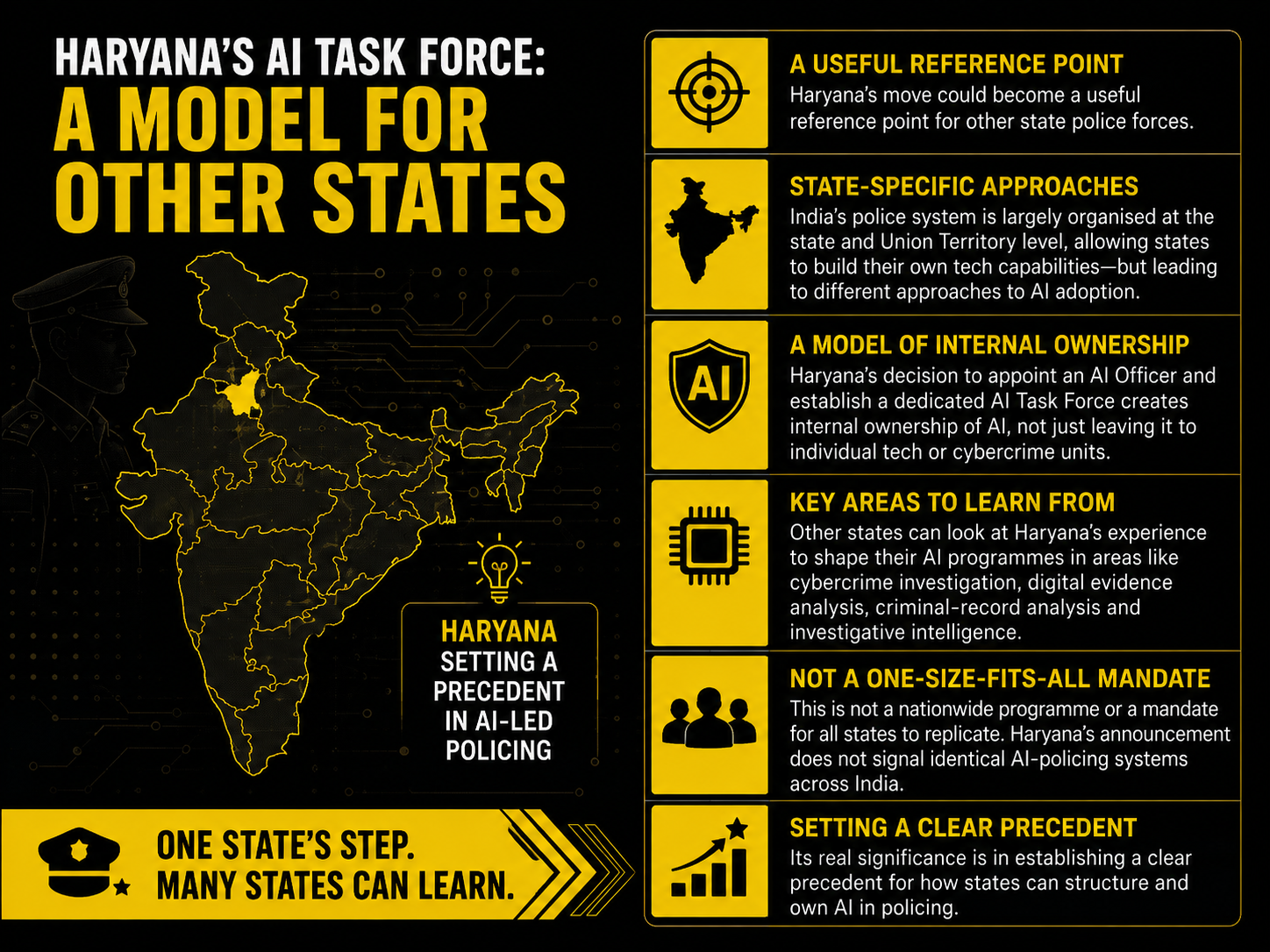
Haryana’s decision to appoint an AI Officer and establish a dedicated AI Task Force offers another possible model: create internal ownership of AI instead of leaving adoption entirely to individual technology or cybercrime units.
Other states could potentially look at the Haryana experience when deciding how to structure their own AI programmes, particularly around areas such as cybercrime investigation, digital evidence analysis, criminal-record analysis and investigative intelligence.
But Haryana’s announcement should not be interpreted as evidence that every state is now moving toward an identical AI-policing system. The official release does not announce a nationwide programme or mandate for other states to replicate the task force.
Instead, its importance lies in establishing a clear precedent.
The bigger picture
The real story here is not about whether police officers will suddenly start relying on AI to solve crimes.
It is about who owns the technology inside a police organisation and how seriously it is treated.
Haryana Police already has AI-enabled capabilities such as EAGLE for criminal-record digitisation, facial recognition, advanced search and criminal-link analysis.
Now, with a dedicated AI Task Force and an IPS officer designated as AI Officer, the department is creating an organisational structure around the wider use of Artificial Intelligence.
For the rest of India’s police forces, that may be the most interesting part of the development.
The next phase of AI in policing is unlikely to be defined simply by who has the most advanced software. It could be defined by how effectively police departments organise people, data, technology and oversight around it.
And Haryana has now taken a significant step in that direction.