ChatGPT for Teens: Is OpenAI making AI safer for teenagers, or making it harder to avoid?
OpenAI’s ChatGPT for Teens is an attempt to make AI use among teenagers safer, but it also raises uncomfortable questions about how much young users should rely on AI. While the new experience adds stronger safeguards, parental controls and learning-focused tools, OpenAI has yet to show how effective these protections will be in practice. The bigger question is whether AI will help teenagers think better, or simply make it easier for them not to think at all.
OpenAI is betting that the answer to teenagers using AI isn’t to keep them away from it, but to build a version specifically for them. That sounds sensible. But it also raises a bigger question: is ChatGPT for Teens really about protecting young users, or about making sure they continue using ChatGPT as they grow up?
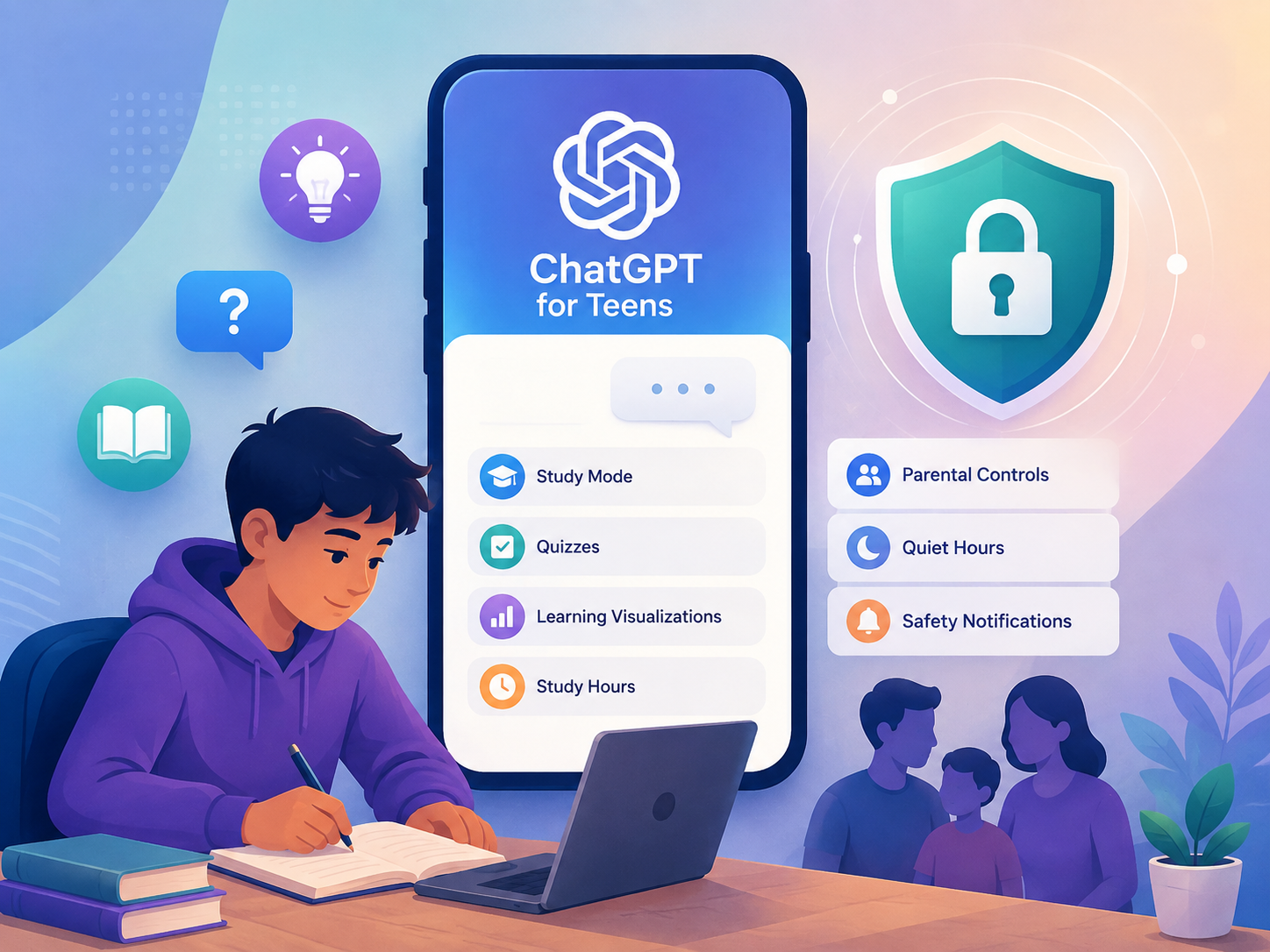
OpenAI has launched ChatGPT for Teens, a dedicated experience for users aged 13 to 17, with Study Mode, quizzes, learning visualisations and additional safeguards around areas such as self-harm, violence, dangerous activities and explicit content. Users identified as being under 18, or those who declare that they are between 13 and 17, will automatically be placed into the teen experience.
On paper, the approach makes sense. Teenagers are already among the people most likely to experiment with new technology, and simply telling them not to use AI is unlikely to solve the problem. OpenAI is instead trying to put guardrails around that usage. Study Mode is particularly interesting because it is designed to guide students through problems rather than simply hand them an answer. But the announcement doesn’t provide evidence showing how effectively these features prevent shortcutting, improve learning or change behaviour. Those questions will ultimately matter more than the feature list.
The same applies to safety. OpenAI says the teen experience has stronger protections and gives parents tools such as Quiet Hours, selected parental controls and safety notifications in limited high-risk situations. But the announcement does not explain exactly how these systems will perform in the real world, how often parents will be alerted, or what happens when age detection gets it wrong. Those details are particularly important when the product is being positioned as a safer environment for minors.
There is also a less comfortable side to this strategy. The easier AI becomes to use during adolescence, the more deeply it can become embedded in how an entire generation learns, searches for information and solves problems. OpenAI’s stated goal is to encourage critical thinking and healthy AI habits, and its new Parents’ Guide asks adults to stay involved. But there is a fine line between using AI as a learning assistant and gradually becoming dependent on it for thinking itself.
That is why ChatGPT for Teens should not be judged simply by how many safety features OpenAI has added. The more important test will be whether teenagers actually become better at learning with AI, or simply better at using AI. OpenAI has built the guardrails. Now it needs to demonstrate that they work.