SpaceX's Terafab: A Bet on Owning the AI Hardware Stack?
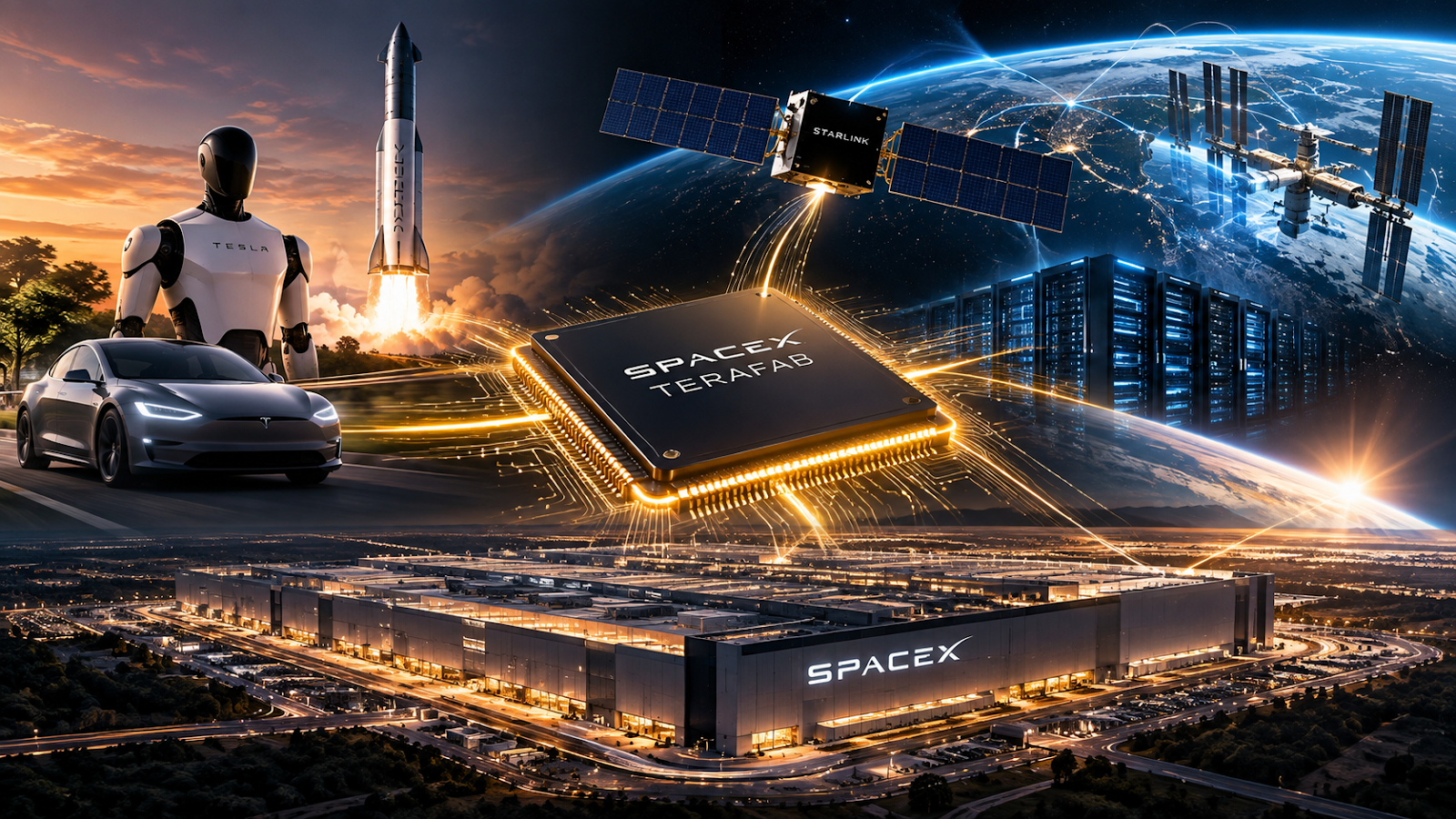
SpaceX’s Terafab is about more than building chips. It is an attempt to control the hardware powering AI, autonomous cars, robots, satellites and, eventually, computing in space.
SpaceX's Terafab semiconductor project in Texas is about far more than chips. It is an attempt to control the hardware behind AI, robots, autonomous cars, satellites and, eventually, computing in orbit. The number that best explains the ambition is 1 terawatt.
SpaceX is building a semiconductor factory in Texas. On the surface, it sounds like another massive manufacturing project. But Terafab could represent something much bigger: an attempt to control the entire hardware stack powering AI, robotics, autonomous vehicles, satellites and, eventually, computing infrastructure in space.
In August 2026, Texas Governor Greg Abbott announced that SpaceX would build Terafab in Grimes County. The first phase involves more than $16.8 billion in capital investment and is expected to create around 3,000 jobs. SpaceX says the planned facility will cover roughly 100 million square feet, which is extraordinary even by semiconductor standards. But the most important number may not be the investment or the size of the factory. It is 1 terawatt. SpaceX says the combined chip requirements of SpaceX and Tesla are expected to eventually exceed 1 terawatt of compute, far beyond current global chip production capacity. Terafab is being built around the idea of closing that gap.
AI's Next Bottleneck Is Not Just Software
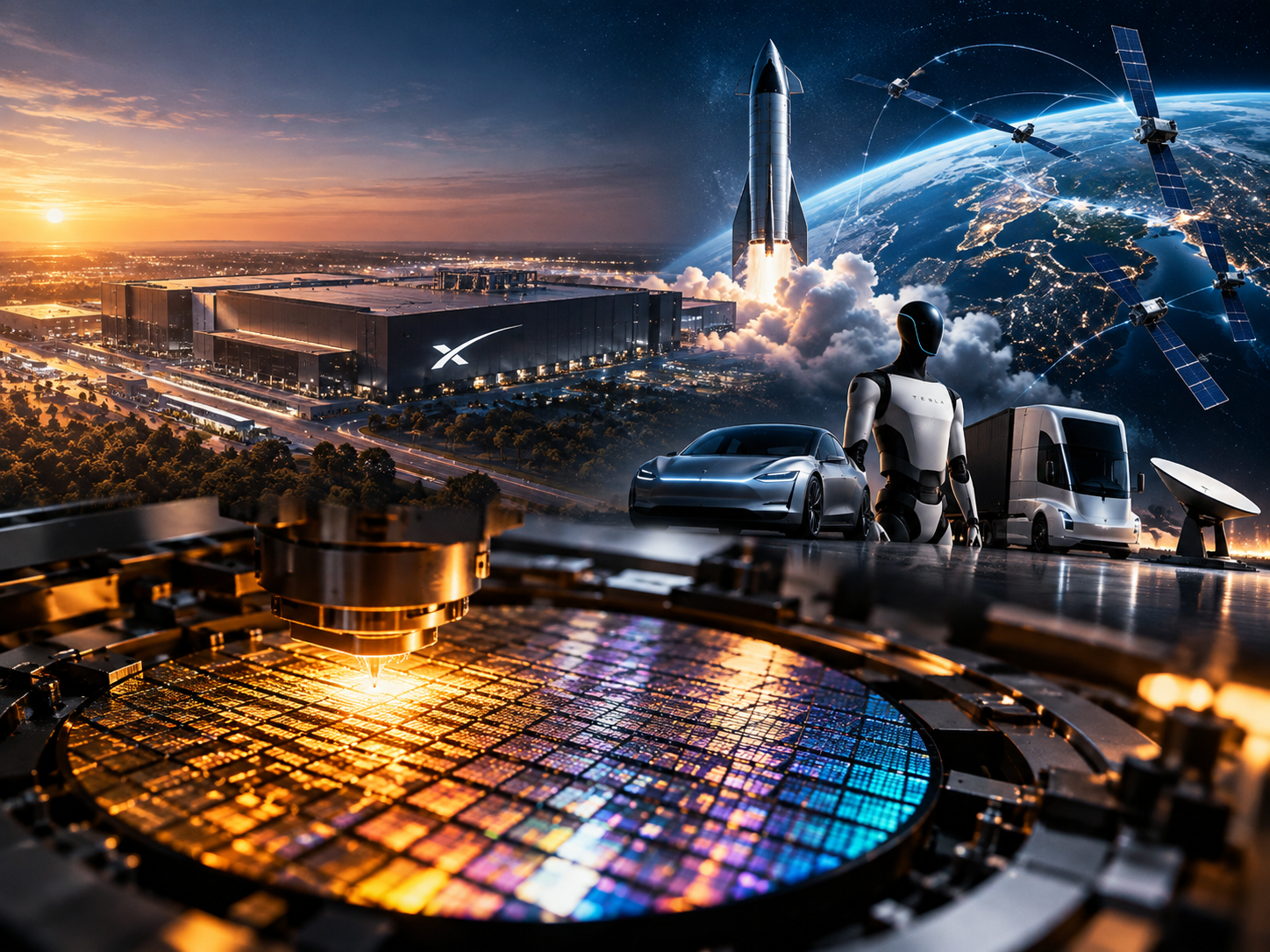
The AI boom has looked like a software revolution. Companies have competed to build bigger language models, better agents and more capable reasoning systems. Underneath all of it sits a physical layer: semiconductors, memory, advanced packaging, networking, data centres and electricity. Demand for compute has grown so fast that access to chips has become a strategic issue, and SpaceX is taking that problem to an extreme. Instead of depending entirely on external manufacturers, it wants a vertically integrated operation that combines logic, memory and advanced packaging under one roof.
That matters because chipmaking is normally fragmented. Designing, fabricating, packaging and integrating a chip can involve different companies, factories and countries. Terafab's proposition is to bring much more of that chain together.
This Is Bigger Than SpaceX
Terafab makes more sense when you look at the companies around it. Tesla needs increasingly powerful chips for autonomous driving and Optimus humanoid robots. SpaceX needs them for rockets, spacecraft and Starlink. AI systems need accelerators. And Elon Musk has increasingly talked about AI compute eventually moving into space. So Terafab isn't designed around a single product. It is positioned as a semiconductor engine for an entire ecosystem. Terafab's own website lists future chip families for Tesla's Full Self-Driving systems and Optimus, alongside chips for space applications and orbital computing.
If one organisation controls chip design, manufacturing requirements, packaging and final hardware, it can optimise the whole system around its own workloads instead of designing around whatever hardware happens to be available.
The Factory Is Only the Beginning
The company says Terafab could eventually produce chips at 1-terawatt-per-year scale, and compares its planned 100-million-square-foot footprint with a 10-million-square-foot Tesla Gigafactory in Texas. These are stated long-term ambitions, not current production. The project will be developed in phases, and earlier filings indicated that total investment could eventually reach approximately $119 billion if every phase is completed.
Terafab isn't producing a terawatt of chips today. What SpaceX is really doing is trying to manufacture its way out of a chip shortage before that shortage starts limiting its ambitions.
Why Tesla Matters So Much
A future where Tesla operates millions of autonomous vehicles and humanoid robots, or eventually far more, would need an enormous amount of specialised computing hardware. Terafab's long-term vision even references 1 billion Optimus robots as part of the manufacturing ecosystem it imagines. That is an aspiration, not a production forecast. But it shows the scale at which Musk's companies are thinking, and Terafab looks designed for exactly that future.
Terafab Didn't Appear Out of Nowhere
SpaceX has been building semiconductor and advanced-packaging capability in Texas for years. In March 2025, Texas announced a $17.3 million Semiconductor Innovation Fund grant for the expansion of SpaceX's Bastrop R&D and advanced packaging facility. That expansion involves more than $280 million in capital investment and more than 400 jobs. Bastrop was planned to grow by approximately one million square feet and support Starlink components, PCBs and advanced packaged silicon. Texas has since expanded its wider semiconductor strategy, with the Innovation Fund receiving approximately $948 million in total appropriations after additional funding in 2025. Terafab looks less like an isolated experiment and more like the next step in SpaceX's move deeper into hardware manufacturing.
Then There Is the Space Angle
SpaceX describes Terafab as a "chip factory built for Earth and orbit." Its argument is that orbital computing could eventually ease the limits facing terrestrial AI infrastructure: energy, land, cooling and construction. AI data centres consume enormous amounts of electricity, need land, generate heat and demand transmission infrastructure. SpaceX's proposed alternative is to put computing in orbit, where solar energy is continuously available. That doesn't mean orbital data centres will replace today's anytime soon. Launch costs, radiation, thermal management, communications, maintenance and basic economics are all serious hurdles. But SpaceX has an advantage most AI companies don't: it runs one of the world's largest launch businesses. That makes the idea far more interesting than it would be for a conventional data-centre company.
Where Starship Fits In
If orbital computing ever becomes viable, the chip factory and the launch system become pieces of the same puzzle. Terafab makes the chips, Tesla and SpaceX build the machines, Starship carries hardware to orbit, solar provides power and an orbital network processes AI workloads. Terafab's website explicitly connects chip production with orbital compute and even discusses scaling launch capacity to 10 million tons of mass per year. Whether every target is met matters less than the fact that SpaceX is planning these pieces as one system.
So, What Does 1 Terawatt Actually Mean?
The figure is deliberately dramatic. Terafab's website compares its proposed 1 TW per year of chip output with annual US electricity consumption of roughly 0.5 TW. This doesn't mean the factory will consume that much electricity. In this context, "terawatt" refers to the computing capacity the hardware is meant to enable, not the factory's own power draw. It points to a future where compute demand becomes an infrastructure problem on a scale rarely seen before.
The AI Race Is Moving From Models to Infrastructure
The first phase of the AI race was about models. Then it became a race for GPUs and accelerators, then for data centres. Now it is increasingly a race for power, chips, manufacturing capacity and physical infrastructure. SpaceX isn't alone in sensing this. The US government, individual states and major tech companies are all investing heavily in semiconductor capacity, and Texas has emerged as a major beneficiary. Terafab fits a wider shift: control over physical infrastructure can matter as much as control over software. It also raises a question for the rest of the industry. If AI demand keeps growing exponentially, can the traditional semiconductor supply chain keep up? Or will the largest tech companies increasingly build their own capacity? SpaceX has an unusual reason to try, since its hardware needs span spacecraft, vehicles, robots, satellites, AI accelerators and possibly orbital systems.
Terafab Has Its Own Complications
The project isn't without controversy. Its scale has already raised questions around local development, tax incentives, infrastructure and transparency. There is also a legal fight over the name. In September 2026, Reuters reported that Tesla and SpaceX sued nanotechnology company TERA-print over the use of the Terafab name, with the case filed in federal court in Austin. Separately, SpaceX has sued Texas officials and Grimes County over the potential release of certain project documents, arguing some information is commercially sensitive. None of this changes the technological ambition. But it shows Terafab is already a major economic and industrial story well before the full facility exists.
More Than a Chip Factory
For decades, tech companies sat at the top of the hardware stack. They designed products and bought components from specialised manufacturers. SpaceX is proposing something different: design the chips, manufacture them, package them and deploy them across vehicles, robots, satellites and computing infrastructure. Then take that ecosystem beyond Earth. Whether SpaceX can manufacture at this scale, whether 1-terawatt annual output becomes economically viable and whether orbital computing can overcome its engineering and financial challenges all remain open questions. But the direction is clear. AI is no longer just a software story. It is becoming a story about fabs, power plants, robots, factories, launch vehicles and satellites.
And if SpaceX connects all of those pieces, Terafab could become much more than a chip factory in Texas. It could be the manufacturing foundation for a new kind of AI infrastructure, built not just for the world we have today, but for the world SpaceX believes could exist beyond Earth.