Apple launches M6 Mac mini and M5 Ultra Mac Studio with a major focus on AI
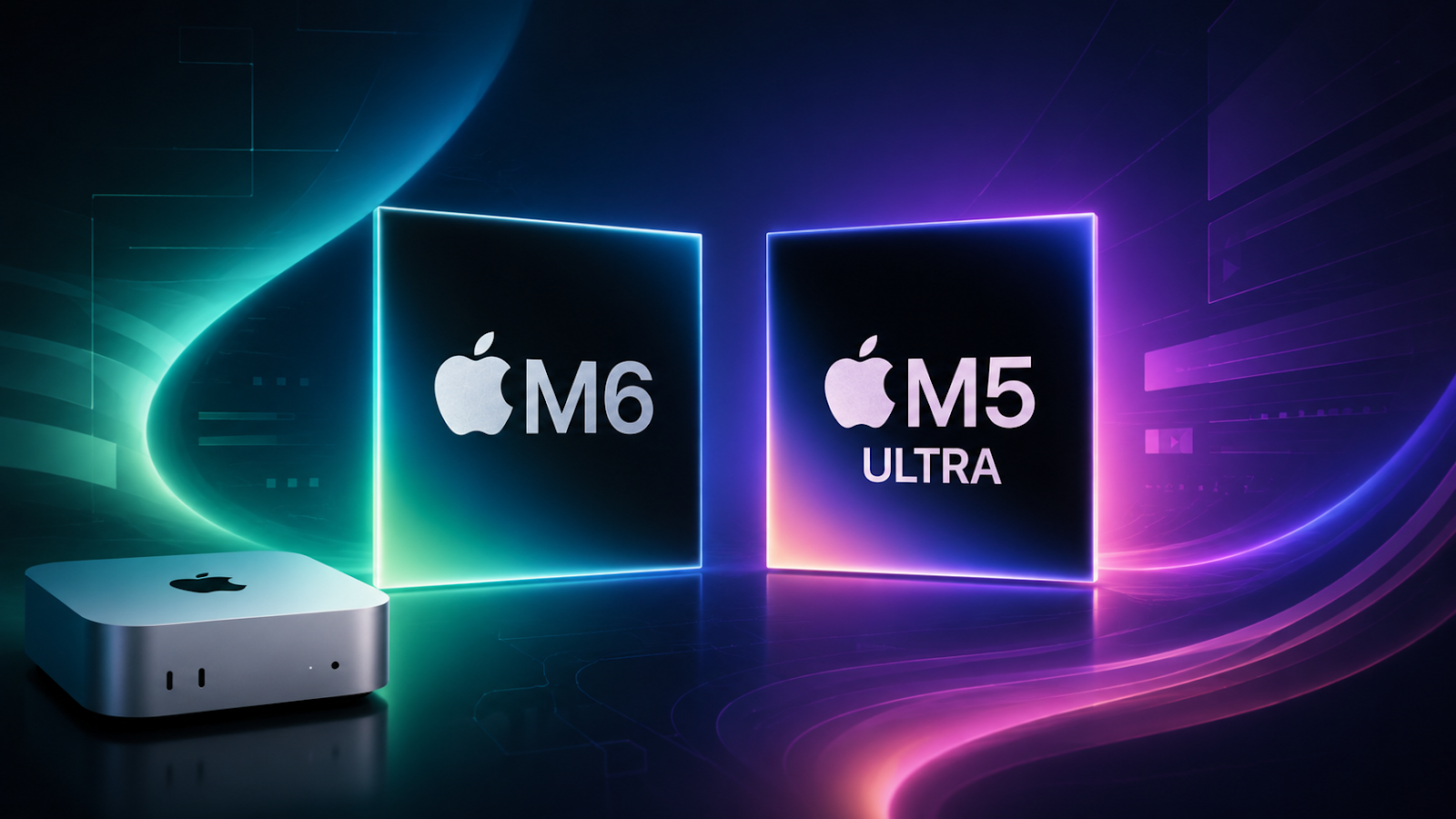
Apple has unveiled its latest Mac desktop lineup, introducing the M6-powered Mac mini and M5 Ultra Mac Studio with a major focus on performance, connectivity and on-device AI. The new chips promise significant gains in CPU, graphics and AI workloads, while the M5 Ultra brings up to 512GB of unified memory for running large AI models locally.
Apple has announced a major refresh of its desktop Mac lineup with the new Mac mini powered by the all-new M6 and M5 Pro, alongside the new Mac Studio featuring M5 Max and the flagship M5 Ultra. The new machines put a strong emphasis on on-device artificial intelligence, higher performance and improved connectivity.
The biggest development is the debut of Apple’s M6 chip, the company’s first 2nm processor. It features a 12-core CPU, a 12-core GPU with Neural Accelerators in every core and a Dual 16-core Neural Engine. Apple says the M6 offers up to 40 percent faster CPU performance, up to four times faster AI performance and up to twice the graphics performance compared with the previous Mac mini with M4.
Mac mini gets the M6 treatment
The new Mac mini is available with either the M6 or M5 Pro. The M6 version comes with 16GB of unified memory as standard and can be configured with up to 32GB. Memory bandwidth has also increased to 170GB/s.

Apple says the M6 Mac mini can deliver up to four times faster AI performance and twice the graphics performance compared with the M4 model. The company also claims up to 13.5x faster LLM prompt processing in LM Studio compared with the M1 Mac mini and up to 4.8x faster performance compared with M4.
The M6 Mac mini also gets hardware-accelerated ray tracing, an updated graphics architecture and Dynamic Caching. Apple says this can deliver up to twice the gaming performance with ray tracing in Cyberpunk 2077: Ultimate Edition compared with the M4 model.
For professional users, the M5 Pro Mac mini offers up to an 18-core CPU, a 20-core GPU and up to 64GB of unified memory with 307GB/s of memory bandwidth. It is aimed at demanding workloads including video production, 3D design, game development, scientific simulations and local AI.
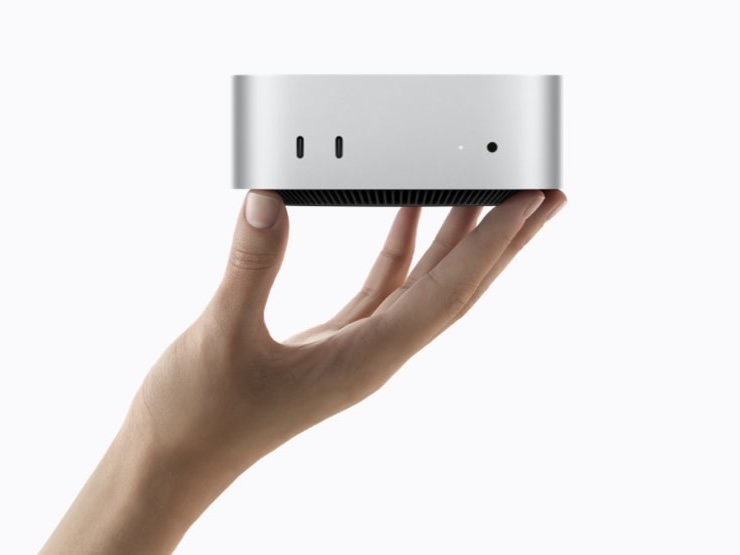
Apple claims the M5 Pro Mac mini delivers up to 8.5x faster LLM prompt processing than the M2 Pro model and up to 4.5x faster ray-tracing performance in Blender than the M2 Pro version.
Connectivity has also been upgraded. Both versions support Wi-Fi 7, Bluetooth 6 and 2.5Gb Ethernet, with a 10Gb Ethernet option. The M6 model has three Thunderbolt 4 ports, while the M5 Pro version gets three Thunderbolt 5 ports.
The new Mac mini starts at Rs. 99,900 in India, with the education price starting at Rs. 88,900. Pre-orders began on August 25, with availability starting September 22.
Mac Studio gets Apple’s most powerful silicon yet
Alongside the Mac mini, Apple has unveiled the new Mac Studio with M5 Max and M5 Ultra. Apple describes the M5 Ultra as its most powerful M-series chip yet, and the Mac Studio as its most powerful Mac.
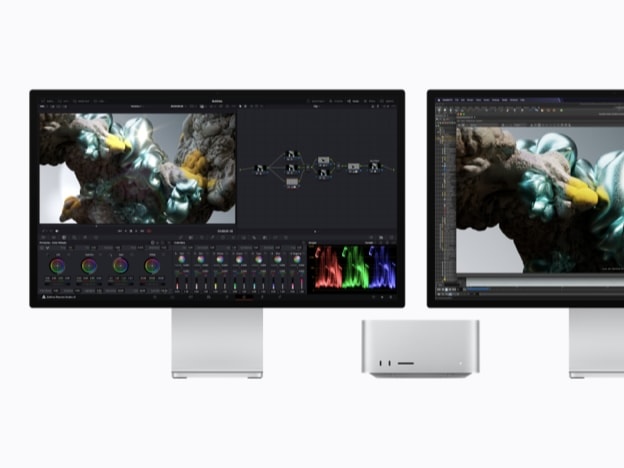
The M5 Max configuration features an 18-core CPU, up to a 40-core GPU with Neural Accelerators and up to 128GB of unified memory. Apple says it delivers up to 3.9x faster AI performance than the previous generation.
The M5 Ultra takes things considerably further, with up to a 36-core CPU, 80-core GPU and 512GB of unified memory. It also offers 1.2TB/s of memory bandwidth, which Apple says is 50 percent higher than the M3 Ultra. This massive memory pool is designed to allow users to run extremely large AI models locally rather than relying entirely on cloud infrastructure.
The M5 Ultra also introduces a new architecture for Apple silicon. It uses UltraFusion to connect two dual-die M5 Max chips, creating a quad-die architecture for the first time in an M-series SoC. Apple says the interconnect provides more than 4.4TB/s of bandwidth between the dies.
On the AI front, the M5 Ultra’s GPU incorporates Neural Accelerators in every GPU core. Apple claims up to 4.5x the peak GPU compute for AI compared with M3 Ultra, while graphics performance is up to 40 percent faster.
The Mac Studio is also designed to scale beyond a single machine. Multiple systems can be connected over Thunderbolt 5 and RDMA to create a shared pool of computing resources. Apple says a cluster can deliver up to three times faster distributed AI inference than a single Mac Studio.
Connectivity includes Wi-Fi 7, Bluetooth 6 and Thunderbolt 5, making the Mac Studio better suited to high-speed external storage, PCIe expansion and professional workflows.
Apple doubles down on local AI
AI is the common thread across Apple’s latest desktop lineup. The company is positioning the M6, M5 Pro, M5 Max and M5 Ultra as processors capable of handling increasingly sophisticated AI workloads directly on the Mac.
Apple’s new Core AI framework is designed to help developers build and deploy AI models on Apple silicon, while the combination of CPU, GPU, Neural Engine and unified memory is intended to let developers run and fine-tune large models locally.
The new Macs will also run macOS 27, which brings Apple’s next generation of Apple Intelligence features, including Siri AI.
For Apple, the message with this generation of desktop Macs is clear: the Mac is increasingly being positioned not just as a traditional productivity or creative machine, but as a platform for local, private and increasingly capable AI computing.
The new Mac mini and Mac Studio are available to pre-order from August 25, with both expected to begin reaching customers from September 22 in India and other markets.